


A sound bath is a guided session where you lie down, stay still, and let sustained tones from instruments like singing bowls, gongs, and chimes wash over you for thirty to sixty minutes. Nothing touches you. There is no water. The name describes being immersed in sound rather than in a tub.
What a sound bath actually does is calmer and more interesting than the marketing suggests. This guide covers what happens in a session, the honest mechanism behind it, what the research does and does not show, and who should be careful. New Wave runs sound bowl therapy as part of the daily schedule, so this is written from inside the room rather than from a brochure.
What Is a Sound Bath, Exactly?
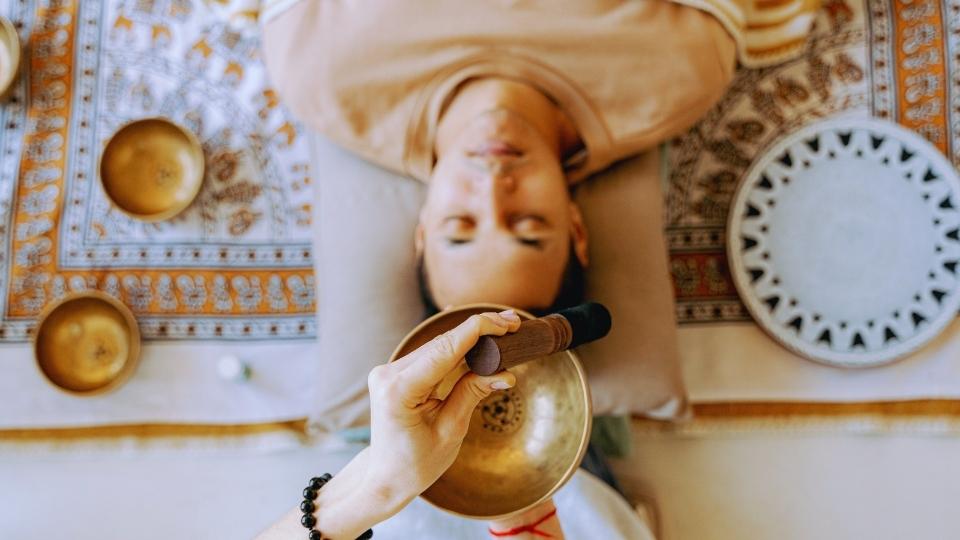
A sound bath is a form of sound bath meditation. A practitioner plays instruments that produce long, overlapping, resonant tones while participants lie on the floor or on couches with their eyes closed. You are not asked to chant, move, or perform anything. Your only job is to listen and stay put. You also do not need to believe anything about energy or frequency to gain benefits from a sound bath meditation, which is worth saying plainly.
A sound bath session is closer to a restorative yoga class than to a concert, and the format is often folded into a meditation practice or offered right after one. It is often described as an ancient practice. That description deserves a small caveat: metal bowls have existed in the Himalayas for centuries, but their use in group meditation sessions of the kind popular now is considerably more recent. The experience is real regardless of how old it is.
Sound baths have become a common feature of yoga studios, wellness centers, and increasingly treatment programs. If you are building a life that does not revolve around drinking, a sound bath is also just a genuinely pleasant thing to do on a Tuesday night, and it belongs on the same list as the other sober activities in Massachusetts worth knowing about.
Sound Healing, Sound Therapy, and Where a Sound Bath Fits
“Sound healing” is a broad, largely unregulated wellness term used for practices involving sound with the intention of promoting relaxation or well-being. “Sound therapy” can mean different things depending on the clinical or wellness context. A sound bath is one form of sound healing among several, and how sound therapy is supposed to work depends heavily on who is describing it. That is part of why the field is confusing.
The physics is simple enough. Instruments produce sound waves, the sound waves reach your ears, and at close range with low frequencies you also feel the sound vibrations in your chest and hands. Certain sounds are easier to relax to than others. Soothing tones with a long decay give the ear something continuous to follow, and practitioners often describe these soothing vibrations as the whole point of sound bath work.
Where it gets slippery is the leap from “soothing sounds are pleasant and relaxing,” which is well supported, to “specific tones produce specific physiological healing,” which is not. Sound healing claims run the full range from modest to absurd, and it is worth knowing which end of that range you are being sold.
What Actually Happens in a Sound Bath Session
What to Bring and What to Expect
Wear loose clothing. Bring a yoga mat, blanket, and pillow if the venue does not supply them, because you will be lying still long enough to get cold. Arrive early enough that you are not rushing in.
A guided sound bath usually opens with a few minutes of instruction and some breath work, including a few deep breaths to settle, then moves into sound. The practitioner may circle the room so the tones arrive from different directions. Sessions typically run thirty to sixty minutes and end with several minutes of silence, which many people find is the most striking part.
What It Feels Like
Honest answer: different for everyone, and often different from one session to the next.
Common reports include physical tension draining out of the shoulders and jaw, a heaviness in the limbs, and the sense of dropping into a deep state of rest, a relaxed state that is not quite sleep. That drain is nervous system regulation happening in real time, the body shifting out of threat mode.
Some people see colors. Some people cry without knowing why. Plenty of people fall asleep, and that is fine. Others feel restless for the first ten minutes and then settle.
Different sensations are normal. So is being underwhelmed. Nothing has gone wrong if your experience was simply pleasant.
The Instruments
Sound bath practitioners work with a small set of tools:
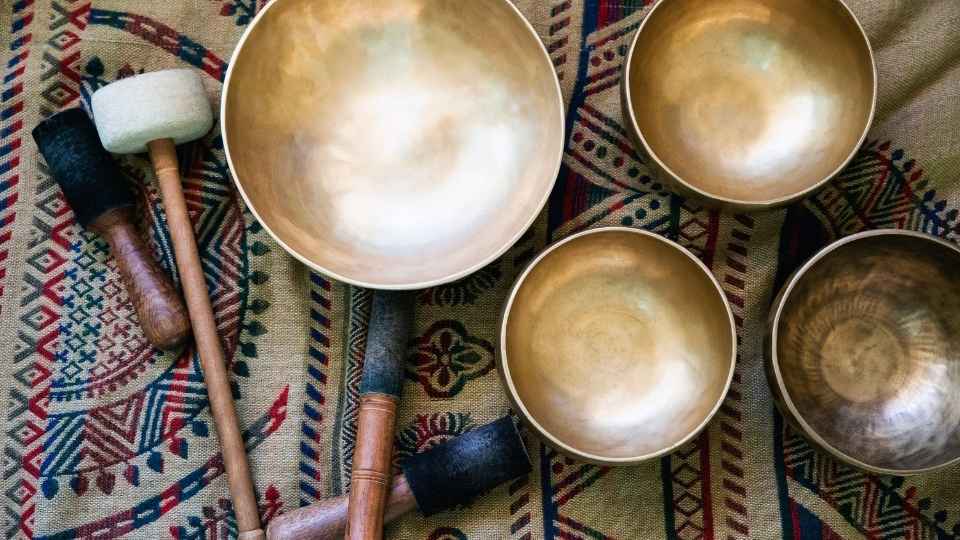
- Tibetan singing bowls, metal bowls struck or rimmed to produce complex overlapping tones
- Crystal singing bowls, made of quartz; Crystal and metal bowls have different acoustic characteristics. Crystal bowls often emphasize strong sustained resonances, while metal bowls can produce complex combinations of fundamental tones and overtones. Pitch varies with the size and construction of the instrument.
- Gongs, for volume and long sustained sound waves that keep rolling after the strike
- Chimes, tuning forks, and rattles, for texture and higher sound frequencies
- Drums, including shamanic drums, which add a steady low pulse
Most practitioners combine several, and many add tuning forks for precision work near the ears. Researchers do not yet know which features of a sound bath matter most. Sustained tones, changes in volume and timbre, focused attention, expectation, relaxation, and the surrounding environment may all contribute.
Unlike conventional songs, sound baths often emphasize sustained tones rather than melody, lyrics, or a familiar rhythmic structure. That can make them useful as a different kind of attentional anchor.
How Sound Baths Work
You may sometimes read that sound baths work by tuning your cells or repairing your DNA. They do not. The plausible mechanisms are more ordinary and better supported.
Lying Still and Breathing Slowly
Slow breathing has real, measured effects: a systematic review of fifteen studies found that breathing under ten breaths per minute increased heart rate variability and respiratory sinus arrhythmia, raised parasympathetic activity, and produced reported increases in comfort and relaxation alongside reductions in arousal, anxiety, depression, anger, and confusion [1].
Relaxation practices can alter autonomic activity, including measures such as heart rate and HRV. Sympathetic and parasympathetic activity interact in more complicated ways than a simple on/off switch. Heart rate settles, and the body starts to relax muscles it had been holding.
These are plausible contributors, but researchers do not yet know which mechanisms account for the observed effects of singing-bowl interventions. Slow breathing and stillness reduce stress measurably, which is why so many practices that promote relaxation converge on the same two ingredients.
One possible benefit of a sound bath is that sustained sound provides an external focus while a person rests quietly. Whether changes in breathing are a major mechanism has not been established.
Sustained Tone Occupies the Mind
The second mechanism is attentional. Overlapping resonant tones give a restless mind something to follow that has no story attached to it. Some people report that attending to changing sounds makes it easier to disengage temporarily from repetitive thoughts. For someone whose head will not stop, an external anchor is easier than an internal one.
Sound is also a real reward, not just a distraction. Using PET imaging, researchers showed that intensely pleasurable music triggers actual dopamine release, with the caudate more involved as you anticipate a peak and the nucleus accumbens more involved as you experience it [2]. Music is one of a handful of evidence-backed ways to increase dopamine naturally, which matters in early recovery when the reward system is running quiet.
What About Brain Waves and Frequencies?
You will see claims about specific tones entraining brain waves, or about particular sound frequencies being uniquely healing. Slow breathing itself does shift EEG activity, increasing alpha and decreasing theta power [1]. But the claim that a specific frequency has a specific therapeutic effect is not established, and the popular idea that one tuning is inherently superior to another has no good evidence behind it.
Sound bath descriptions also frequently refer to energy centers or chakras. That framing comes from a spiritual tradition, not from physiology. Some people find it meaningful and it is not our place to take that away, but we are not going to present it to you as biology. The same distinction applies to Reiki, another practice where the felt experience is real even though the traditional explanation is not physiology.
Sound Bath Benefits: What the Evidence Actually Shows
The research on sound baths specifically is early and small. That is the honest headline, and anyone telling you otherwise is overselling. Studies remain relatively small and heterogeneous, and many have important risk-of-bias limitations.
Where researchers suggest a benefit, it is almost always on self-reported mood and tension rather than on a hard clinical outcome. Most of what has been studied concerns stress and anxiety in the short term, which is also what people mostly come for.
The most cited study observed 62 adults before and after a single sixty-minute Tibetan singing bowl session. Participants reported significantly less tension, anger, fatigue, and depressed mood afterward, and increases in spiritual well-being. Notably, people new to the practice showed greater reduction in tension than experienced practitioners did [3]. The paper appeared in the Journal of Evidence-Based Integrative Medicine. The authors were careful about the limitation: it was a nonrandomized observational study with no control group, which they described as its most notable weakness, and they framed the work as groundwork for future randomized trials.
So what can be said fairly? A single session appears to reduce self-reported tension and improve mood, and the effect is consistent with what slow breathing and focused attention do generally. That is a modest, real claim, and it is the honest version of the benefits of sound work.
Put another way: the realistic health benefits are the ones you would expect from forty minutes of deep rest. Better mood, less physical tension, a temporary sense of emotional balance, and sometimes a feeling that something has begun to restore balance after a hard stretch. Those are worth having. They are not the same as treatment, and sound baths belong in the category of complementary therapies that support healing alongside real clinical care rather than standing in for it.
The measured effects on mental health are real but small. Pain has been studied, with mixed results. Some studies have reported reductions in pain after singing-bowl interventions, but small samples, placebo effects, and methodological limitations prevent sound baths from being considered an established pain treatment.
For context on the wider category, NCCIH notes that much of the research on mind and body practices has been preliminary or not scientifically rigorous, and that results have sometimes been interpreted too optimistically [4]. Sound baths sit squarely inside that caution.
What Sound Baths Do Not Do
Sound baths are not established standalone treatments for substance use disorders, anxiety disorders, depression, pain, hypertension, or other medical conditions. They may be used as complementary practices alongside evidence-based care, and preliminary clinical research is evaluating whether they can improve particular symptoms. They are typically not used for:
- They do not treat substance use disorder, depression, anxiety disorders, or any medical condition on their own.
- Small studies have reported short-term changes in heart rate and blood pressure, but results are inconsistent, and the evidence is not strong enough to recommend sound baths as treatment for high blood pressure.
- They do not detoxify anything
- They do not repair cells or alter DNA
- They are not a substitute for therapy, medication, or medical care
NCCIH is direct on the last point, advising people not to use these practices to replace conventional care, or as a reason to postpone seeing a health care provider about a medical problem. A sound bath is a complementary therapy. Complementary means alongside, not instead of. What it complements is the clinical work of rewiring, which our guide to how the brain heals in recovery lays out in full.
Who Should Be Cautious
Sound baths are low risk for most people, but not zero risk, and the honest version of that includes a few cautions.
If you are managing stress and anxiety with the help of a clinician, mention that you are trying this, the same way you would any new practice. Pregnancy is not an established contraindication to an ordinary sound bath. Very loud sound and direct exposure to strong low-frequency vibration should be avoided during pregnancy, so ask about volume and avoid placing the body directly against strongly vibrating equipment.
Some practitioners also ask about metal implants or pacemakers. A standard noncontact sound bath is not known to interfere with metal implants or pacemakers. If instruments or vibrating devices will be placed directly on the body, ask the practitioner exactly what equipment is being used and check with your clinician if you have an implanted medical device.
If you live with PTSD, be aware that lying still with your eyes closed in a dim room can occasionally surface more than expected, which is a good reason to try it somewhere with clinical support present.
It is also worth knowing that meditative practices are not universally benign. In one review NCCIH cites, about 8 percent of participants reported a negative effect from meditation, most often anxiety or low mood [4]. That is a small minority, and it is not nothing. If a session leaves you agitated, that is information, not failure.
Sound Baths and Recovery
Early recovery is a period when the body is loud. During withdrawal, stress-related circuits involving the extended amygdala can become increasingly active, contributing to anxiety, irritability, dysphoria, and unease. [5]. Acute withdrawal timelines vary widely by substance and degree of dependence. Some symptoms resolve within several days, while others can continue for weeks, with sleep, mood, stress sensitivity, or craving lasting longer.
That is one reason a relaxation-focused activity may feel useful during recovery. Sound baths have not been shown to correct addiction-related stress circuitry or treat SUD itself, but they may provide some people with a structured period of relaxation alongside clinical care.
There is a practical reason this matters more in recovery than in a wellness context. Some people find silent meditation difficult in early recovery because cravings, anxiety, restlessness, or intrusive thoughts become more noticeable. For the craving part specifically, urge surfing applies the same attentional skill directly to the urge itself.
An external sound anchor may feel more accessible for those individuals. Sitting in silence with your own thoughts is precisely the thing that feels unbearable. For some people, focusing on sound may make stillness easier than silent meditation.
At New Wave Recovery Center, sound bowls and sound baths are part of the daily schedule rather than a monthly extra, woven between the clinical groups alongside recovery yoga, individual and group Reiki, mindfulness, and art therapy. Ryan, one of the owners, leads the sound and frequency work. Sessions happen on the same big leather couches the groups run on, in a homey space rather than a sterile one, which matters more than it sounds like it should. A comfortable, non-institutional environment may make it easier for some people to relax and engage with the experience.
New Wave is family-owned and run by people in long-term recovery, on the North Shore of Massachusetts about ten minutes from the beach. Day treatment runs about six weeks, the intensive outpatient program about three months, and the Relapse Prevention Program up to six months. New Wave is in-network with WellSense and approved through MassHealth. When you call, you talk to someone in recovery.
If you are in crisis or thinking about harming yourself, call or text 988 to reach the Suicide and Crisis Lifeline. For treatment referrals, the national helpline at 1-800-662-HELP is free and open at all hours.
Sound Bath FAQs
What does a sound bath do?
A sound bath provides a period of rest and focused auditory attention. Small studies suggest it can influence self-reported anxiety, mood, HRV, and other measures, but researchers have not established one primary biological mechanism.
Is a sound bath the same as music therapy?
No. Music therapy is an established clinical health profession with formal education, supervised clinical training, and the national MT-BC credential. State licensure or legal recognition varies by jurisdiction. A typical sound bath does not meet the professional definition of music therapy simply because it uses sound or music.
How often should I go?
There is no established evidence-based frequency. If you find sound baths relaxing and they do not interfere with appropriate care, frequency can be based on preference, cost, convenience, and how you respond.
Can a sound bath help with sleep?
Many people report it helps them fall asleep and stay asleep on the night of a session, though this has not been well studied. The slow breathing and reduced physical tension are plausible reasons. Better sleep pays a second dividend, since sleep debt is one of the drivers of brain fog after quitting drinking.
Is it normal to fall asleep during a sound bath?
Completely normal, and very common. You still get the benefit of the rest.
Do I need experience?
No, and the research offers a small encouragement here: in the singing bowl study described above, first-time participants showed greater reduction in tension than experienced practitioners.
Sources
- Zaccaro A, Piarulli A, Laurino M, et al. How Breath-Control Can Change Your Life: A Systematic Review on Psycho-Physiological Correlates of Slow Breathing. Frontiers in Human Neuroscience. 2018;12:353. https://www.frontiersin.org/journals/human-neuroscience/articles/10.3389/fnhum.2018.00353/full
- Salimpoor VN, Benovoy M, Larcher K, Dagher A, Zatorre RJ. Anatomically distinct dopamine release during anticipation and experience of peak emotion to music. Nature Neuroscience. 2011;14:257-262. https://www.nature.com/articles/nn.2726
- Goldsby TL, Goldsby ME, McWalters M, Mills PJ. Effects of Singing Bowl Sound Meditation on Mood, Tension, and Well-being: An Observational Study. Journal of Evidence-Based Integrative Medicine. 2017. https://journals.sagepub.com/doi/full/10.1177/2156587216668109
- National Center for Complementary and Integrative Health. Meditation and Mindfulness: Effectiveness and Safety. https://www.nccih.nih.gov/health/meditation-and-mindfulness-effectiveness-and-safety
- National Institute on Drug Abuse. Drugs, Brains, and Behavior: The Science of Addiction: Drugs and the Brain. https://nida.nih.gov/publications/drugs-brains-behavior-science-addiction/drugs-brain